MfL
This page holds all the Subject Leadership Information for Modern Foreign Languages at Rosehill Junior School. At Rosehill we follow the National Curriculum focusing on the 5 key language skills.
-
Speaking
-
Listening
-
Reading
-
Writing
-
Grammar
We use the scheme 'Language Angels'.
Statement of Intent
At Rosehill Junior School, we intend to deliver a high-quality, ambitious and inclusive Spanish curriculum that inspires curiosity, broadens cultural understanding and equips pupils with the knowledge and confidence to communicate in another language.
In line with the National Curriculum, learning Spanish provides pupils with an opening to other cultures and perspectives, fostering respect, global awareness and a deeper understanding of the world. Through carefully sequenced teaching, pupils develop the ability to understand and respond to spoken and written language, express ideas with increasing confidence and accuracy, and appreciate cultural traditions from across the Spanish-speaking world.
We use the Language Angels scheme of work and resources to ensure our curriculum is broad, progressive and coherently structured. The scheme enables us to offer a dynamic programme of study built around age-appropriate topics and themes, while ensuring systematic progression in phonics, vocabulary and grammar.
Our curriculum is designed so that:
-
Knowledge builds cumulatively within and across year groups.
-
Pupils revisit and apply previously taught language to strengthen retention.
-
Phonological awareness is explicitly taught and regularly reinforced.
-
Grammar is introduced in meaningful contexts and increases in complexity over time.
-
All four key skills - listening, speaking, reading and writing - are developed in balance.
We maintain high expectations for all learners. Every pupil is expected to achieve their full potential in Spanish through structured support, clear modelling and carefully scaffolded progression towards independence.
Inclusion is central to our intent. The curriculum is designed to remove barriers to learning and ensure that pupils with SEND can access and succeed in language learning. Through planned scaffolding, systematic recycling and reduced cognitive overload, we ensure that all pupils can experience success and develop confidence.
Ultimately, we aim for pupils to leave Rosehill as motivated, resilient and capable language learners who feel willing and able to continue studying languages beyond Key Stage 2.
Statement of Implementation
Spanish is taught in Key Stage 2 through weekly, well-planned lessons using the Language Angels scheme of work. Lessons are structured to progressively develop pupils’ skills in listening, speaking, reading and writing, alongside secure grammatical understanding.
Curriculum Structure and Progression
Language Angels units are categorised by “Teaching Type” to ensure appropriate challenge and progression:
-
Early Language units (entry level)
-
Intermediate units
-
Progressive Curriculum units
This structure ensures that language is introduced when pupils are developmentally ready and that complexity increases systematically across the primary phase.
Across units, pupils progressively acquire, use and apply a growing bank of vocabulary and grammatical structures. Learning is organised into manageable blocks so that pupils build language in stages, combining vocabulary and structures to create increasingly complex and authentic communication.
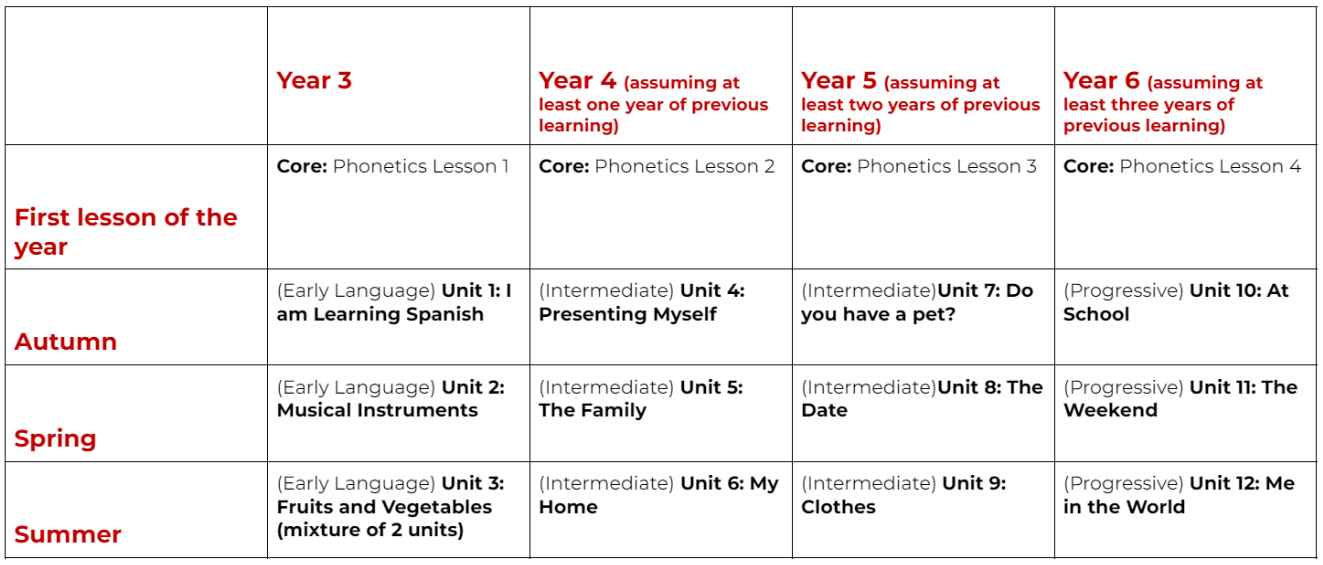
Each unit consists of six sequenced lessons, with clearly defined objectives and outcomes. Lessons are cumulative: new knowledge builds on prior learning and previously taught language is deliberately recycled and revisited to strengthen long-term retention.
A whole-school unit planner maps progression across year groups to ensure continuity and coherence. The Language Angels Progression Map and Grammar Grid are used to ensure that pupils are taught the appropriate grammar concepts at the correct stage in their learning journey.
Phonics, Vocabulary and Grammar
The Spanish curriculum at Rosehill Junior School is constructed around the three core pillars of language learning: phonics, vocabulary and grammar. These pillars are deliberately built into every lesson and unit through the Language Angels scheme and are developed progressively across the three teaching types (Early Language, Intermediate and Progressive Curriculum).
We do not view phonics, vocabulary and grammar as separate strands. They are intrinsically linked and function together to enable meaningful communication.
-
Phonics represents the smallest sounds within the Spanish language. Pupils are explicitly taught sound–spelling correspondences and pronunciation patterns so that they can decode unfamiliar words, read accurately and pronounce language with increasing confidence.
-
These phonemes are combined to form words (vocabulary). Vocabulary is carefully selected, sequenced and systematically revisited so that pupils build a secure and cumulative bank of language.
-
Grammar provides the structure that enables pupils to combine words in a way that conveys precise meaning. Through explicit and contextualised grammar teaching, pupils learn how to manipulate vocabulary to form coherent sentences.
Phonics underpins all language learning. At the start of each academic year, each year group focuses on a carefully sequenced set of Spanish phonemes. Four progressive phonics lessons are built into long-term planning, moving from recognition of individual sounds to applying them in high-frequency words and longer contextualised texts.
Grammar progression follows a structured pathway:
-
Early units focus on nouns, articles and first-person high-frequency verbs.
-
Intermediate units introduce possessives, adjectives, negatives, conjunctions and regular verb conjugation.
-
Progressive units develop opinion phrases and irregular high-frequency verb forms.
Grammar is embedded within meaningful contexts and revisited regularly to ensure understanding and application. Dedicated grammar teaching may be used to consolidate knowledge where appropriate.
Teaching Approach
Lessons are designed to ensure clarity, accessibility and progression for all pupils.
Teaching sequences typically move from:
-
Listening and modelling
-
Guided practice with scaffolds
-
Structured speaking and reading
-
Supported writing
-
Independent application
Scaffolding is gradually reduced as pupils gain confidence. Writing tasks are carefully staged to reflect their higher cognitive demand.
Interactive whiteboard materials, structured speaking tasks and purposeful listening activities are central to lessons. Reading and writing activities are incorporated within all units.
Tasks are designed to allow multiple entry points, ensuring that all pupils can participate meaningfully while enabling deeper challenges for those ready to extend their learning.
Subject Knowledge and Staff Support
Spanish is delivered by class teachers using the structured support provided through the Language Angels scheme. We recognise that not all teachers are specialist linguists; therefore, high-quality subject support is embedded within our provision.
The Language Angels platform provides accurate native-speaker audio for all vocabulary, phonics and model sentences. These audio tools are routinely used in lessons to model precise pronunciation and intonation, ensuring pupils hear authentic language and develop accurate phonological understanding.
This approach supports teacher confidence, ensures consistency across year groups and maintains high standards of subject accuracy. The structured planning, progression mapping and audio modelling enable all staff to deliver the Spanish curriculum effectively and with fidelity.
Inclusion
The curriculum is implemented in a way that ensures accessibility for all learners. This includes:
-
Clear modelling and repetition
-
Visual supports and sentence frames
-
Word banks and structured tasks
-
Gradual progression from supported to independent work
-
Regular recycling of previously taught language
-
Predictable lesson routines
Listening and oral rehearsal are prioritised to support pupils who may find written tasks more demanding. Tasks are broken into manageable steps and structured to build confidence and success.
Differentiation is built into lesson design rather than relying on separate worksheets, ensuring that pupils are supported without being separated from their peers.
Assessment and Monitoring
Pupil learning and progression are assessed at regular intervals in line with school policy. Teachers assess each of the four key skills throughout the year to provide clear reference points for progression.
Assessment includes:
-
Observation of spoken language
-
Listening and reading responses
-
Marking of written work
-
Language Angels end-of-unit assessments
Assessment outcomes inform planning and ensure that learning is secure before new content is introduced.
Enrichment and Cultural Development
Cultural understanding is an integral part of our Spanish curriculum and is woven throughout units of work rather than taught in isolation. We aim to develop pupils’ awareness of the diversity, traditions and lived experiences of people across the Spanish-speaking world, fostering respect, curiosity and global citizenship.
In addition to curriculum-based cultural content within Language Angels units, enrichment opportunities at Rosehill may include:
-
Whole-school assemblies focused on significant Spanish celebrations.
-
Exploration of traditional Spanish foods through structured tasting experiences, enabling pupils to engage with cultural traditions in an authentic and memorable way.
-
Learning about Spanish music and dance, including an introduction to Flamenco, its historical roots and cultural significance.
-
Study of national celebrations and traditions across Spain and other Spanish-speaking countries.
These experiences deepen cultural awareness and strengthen pupils’ understanding of identity and global citizenship.